A good late payment reminder is short, specific, and calm. Mention the invoice number, balance due, original due date, and the easiest way to pay.
The goal is not to sound aggressive. The goal is to remove friction so a busy customer can recognize the invoice and pay without extra back-and-forth.
If your original terms allow a fee, estimate it first before adding numbers to your reminder.
Open Late Fee CalculatorLate Payment Reminder Tone Comparison
| Stage | Tone | What To Include | Avoid |
|---|---|---|---|
| First Reminder | Friendly and helpful | Invoice number, amount, due date, payment link or method | Threats, blame, long explanations |
| Second Reminder | Direct but professional | Balance, days overdue, requested payment date | Sarcasm or emotional language |
| Final Notice | Firm and documented | Prior reminders, balance, next step, deadline | Promises you cannot or will not follow |
| Internal Note | Private record | Date sent, channel, response, next follow-up date | Relying only on memory |
First Reminder Template
Subject: Friendly Reminder: Invoice [Number] Due
Hello [Name], just a quick reminder that invoice [Number] for [Service] shows a balance of [Amount], originally due on [Date]. Payment can be sent by [Methods]. Please let me know if you need the invoice resent or if payment has already been sent. Thank you.
Second Reminder Template
Subject: Follow-Up On Invoice [Number]
Hello [Name], I am following up on invoice [Number] for [Amount], which was due on [Date]. Please send payment by [Requested Date] or reply with an update so I can keep the account records current.
Step-By-Step Reminder Workflow
- Check The Invoice First. Confirm the invoice number, due date, Balance Due, payment terms, and any Amount Paid / Deposit Credited. Do not send a late-payment reminder when the document shows a Credit / Overpayment Balance.
- Send A Friendly First Reminder. Use a calm tone and ask whether the customer needs the invoice resent or payment details confirmed.
- Send A Firmer Follow-Up. If there is no response, repeat the balance, due date, payment methods, and requested payment date.
- Document Every Contact. Keep copies of messages and note call dates so your records stay organized.
- Escalate Carefully. Before fees, holds, or collections, review your agreement and applicable rules for your location and industry.
What Triggers A Reminder — And Why We Have Never Charged A Late Fee
Our reminders are triggered by the payment tracker rather than by a date on a calendar. Two conditions prompt a note: an event coming up with the advance still unpaid, and a completed event with the balance outstanding. Both are visible at a glance because unpaid rows stay marked until the money arrives.
In practice, very few clients delay, and we have never charged a late fee. The clause exists in our terms so they are complete, not because it gets used — a polite, factual note has resolved every case. Escalation exists for a genuinely delinquent account, but it is rare enough that treating it as the normal next step would poison a lot of good relationships to recover very little money.
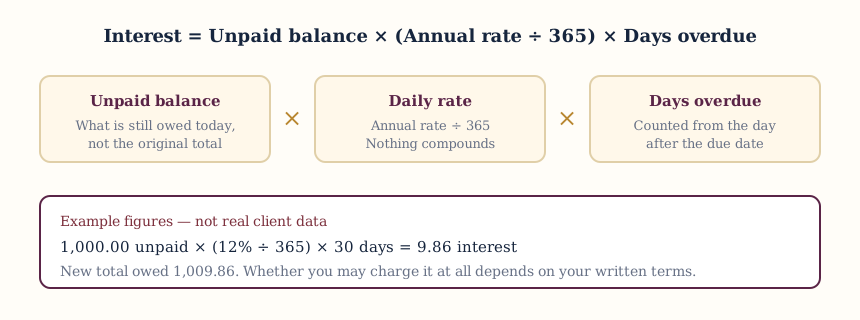
Before adding a fee to anything, run the number in the late fee calculator. Thirty days at 12% on a thousand is under ten. Deciding whether that is worth the conversation is usually a shorter deliberation than writing the letter.
ClearPaperwork lets you create clear invoices with Balance Due, payment method and terms, Amount Paid / Deposit Credited, taxable line markers, and PDF output before you need to follow up.
Open Invoice GeneratorWhat To Include In Every Reminder
- Invoice number so the customer can find it quickly.
- Balance due so there is no guessing.
- Original due date so the reminder is grounded in the document.
- Payment methods so the customer knows how to pay.
- Clear next action such as “please send payment” or “please reply with an update.”
What Not To Write
Avoid emotional statements like “You ignored my invoice” or “This is unacceptable” in early reminders. Those lines may feel satisfying for five seconds, but they often make collection harder.
Use the facts instead: invoice number, due date, Balance Due, payment method, paid/credited amount if relevant, and next step.
Before You Add Late Fees
Late fee rules and enforceability can vary. Before adding a fee, make sure the fee was included in the original terms and that it fits any rules that apply to your location and industry.
This guide provides general communication examples and organization tips. It is not legal, financial, or collection advice.
Some links may be affiliate or partner links, which means ClearPaperwork may earn a commission at no extra cost to you.
View Reminder TemplateFAQ
When should I send a late payment reminder?
Many small businesses send a friendly reminder shortly after the due date, then follow up again if there is no payment or response.
How do I remind someone without sounding rude?
Keep it specific and calm. Mention the invoice number, balance, due date, and payment method, then ask for a status update.
Should I mention late fees in the first reminder?
Usually, keep the first reminder friendly. Only mention fees if they were included in the original terms and are allowed under the rules that apply to your business.