An estimate explains expected work before the customer commits. An invoice asks for payment. A receipt proves payment happened. Use them in that order when you want clean records and fewer payment arguments.
For service businesses, the difference matters because each document answers a different customer question: What will it cost? What do I owe? What did I pay?
Quick Comparison: Estimate vs Invoice vs Receipt
| Document | Best Time To Use It | Primary Purpose | Payment Status |
|---|---|---|---|
| Estimate | Before work starts | Shows proposed scope, price, and assumptions | Usually no payment due yet |
| Invoice | When payment is due | Requests payment for approved or completed work | Balance Due until paid; can show Amount Paid / Deposit Credited |
| Receipt | After money is received | Confirms payment, method, and payment history | Paid In Full, Remaining Balance Due, or Credit / Overpayment Balance |
| Cash Receipt | Immediately after physical cash is received | Documents cash payments received and reduces cash-payment disputes | Useful for deposits, partial payments, final payments, and overpayments |
When To Send Each Document
Send An Estimate Before The Customer Says Yes
An estimate belongs at the decision stage. It should describe the job, expected price, optional items, any advance-deposit requirement, and how long the estimate remains valid. Use the Advance Deposit Calculator at this stage if you need a clear upfront amount or percentage before the customer approves the work.
Keep the wording clear enough that a customer can approve it without calling you to decode the numbers.
Send An Invoice When Payment Is Due
An invoice turns approved work into a payment request. It should include an invoice number, invoice date, due date, line items, taxable-item marking if needed, Amount Paid / Deposit Credited for money already received or credit applied, and Balance Due. If the invoice began from an estimate, review the invoice date instead of leaving an old estimate date in place.
Never credit a deposit that has only been requested. Credit only money that has actually been received.
Send A Receipt After Payment
A receipt closes the loop. It should show the amount received, final payment date, payment method, what the payment covered, payment history if there was a prior payment, and whether any balance remains. When the final payment is what completes the transaction, use that final payment date as the main receipt date.
Use the regular Receipt Generator for cash, check, card, bank transfer, Zelle, Venmo, or mixed payment methods. Use the Cash Receipt Generator when the payment method is physical cash and you want cash-specific labels.
Step-By-Step Workflow For A Clean Paper Trail
- Start With An Estimate. Before work begins, describe the proposed scope, expected price, timing, and any assumptions so the customer knows what they are approving.
- Confirm Approval. Get written approval by email, message, signature, or another method you can later reference if the job changes.
- Track Real Payments. Record deposits and partial payments only after the money is actually received.
- Send The Invoice. Use approved customer and line-item details to create a payment request, then confirm the invoice date and enter invoice-specific payment terms and notes. Show any paid deposit or credit already applied.
- Issue The Receipt. After payment, provide a receipt showing what was paid, how it was paid, the final payment date, and whether the balance is paid in full, still due, or overpaid.
The Whole Sequence On One Page
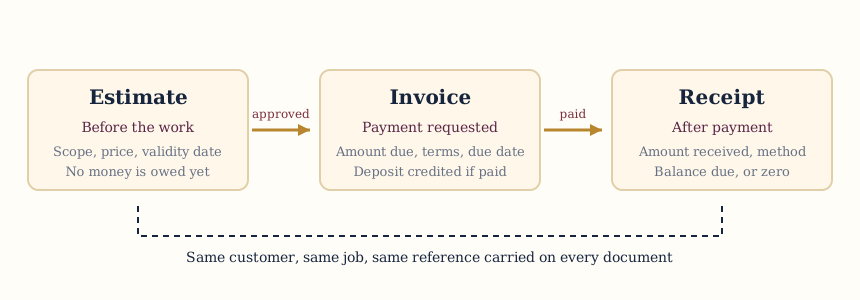
The documents are easy to tell apart once you see them in order: the estimate proposes, the invoice requests, the receipt confirms. What makes the set useful is not any one of them but the reference carried across all three, so that six months later you can put a payment next to the work it paid for without reconstructing anything from memory.
ClearPaperwork is designed for browser-based estimates, invoices, receipts, and cash receipts with no signup required.
Start With An EstimateReceipt And Cash Receipt Examples
Example 1: Handyman Repair
The customer asks for a door repair quote. You send an estimate. After approval and completion, you send an invoice. When the customer pays, you issue a receipt showing payment method and zero balance.
Example 2: Event Vendor Deposit
You send an estimate for the event package and include advance-deposit wording from the Advance Deposit Calculator. After the customer actually pays the deposit, the invoice shows Amount Paid / Deposit Credited and the receipt can later show prior payment plus final payment, with the receipt date matching the final payment date.
Example 3: Cash Lawn Service
The customer pays cash after weekly service. A cash receipt gives both sides a simple record of the date, amount, service completed, cash method, and paid-in-full status.
Example 4: Customer Overpayment
If the customer pays more than the final total, do not hide the extra amount. The receipt should show Credit / Overpayment Balance so the refund, future credit, or adjustment can be handled clearly.
Common Mistakes To Avoid
- Using an estimate as if it were proof of payment.
- Reducing an estimate total for a deposit that has not actually been received.
- Sending an invoice without a due date or payment method.
- Failing to show deposits already paid.
- Marking a receipt paid in full when a remaining balance still exists.
- Leaving a final receipt with an old estimate or invoice date instead of the final payment date.
- Hiding a credit or overpayment instead of showing a Credit / Overpayment Balance.
- Giving cash customers no written cash receipt.
- Changing the final invoice without explaining approved changes.
Best Practice For Small Service Businesses
Use a simple sequence: estimate, approval, invoice, payment, receipt. When cash is involved, issue the cash receipt immediately and keep a copy. That sequence gives your customer a clear paper trail and gives your business a cleaner record for follow-up, bookkeeping, and job history.
This guide is for general organization, not legal, tax, or accounting advice. Requirements can vary by location and industry, so verify any local rules that apply to your business.
Some links may be affiliate or partner links, which means ClearPaperwork may earn a commission at no extra cost to you.
Try Advance Deposit Calculator Browse TemplatesFAQ
Is an estimate the same as an invoice?
No. An estimate explains expected work and pricing before the customer owes payment. An invoice requests payment after work is approved, started, completed, or billed according to your agreement.
Should I send a receipt after every payment?
Yes, especially for cash, deposits, partial payments, and final balances. A receipt prevents confusion about what was paid and what remains due.
When should I use a cash receipt instead of a regular receipt?
Use a cash receipt when physical cash is received and you want cash-specific wording, advance payment received, final payment received, and receiver/signature details.
Can a receipt show an overpayment?
Yes. If total payments exceed the receipt total, show the extra amount as a Credit / Overpayment Balance.